MMODA — Multi-Messenger Online Data Analysis
MMODA (Multi-Messenger Online Data Analysis) is a web platform for analysing data from astrophysical observatories with no software installation. The platform's Ukrainian node is deployed and maintained at Taras Shevchenko National University of Kyiv within the ACME project.
About the platform
MMODA is an open web platform providing access to the data-analysis pipelines of leading astrophysical instruments through a single browser interface. The user formulates a request in astronomical terms — a source, coordinates, a time interval, a product type — and the platform performs the computation on server infrastructure and returns ready scientific products: spectra, light curves, sky maps, spectrograms.
The platform was created within the ODA (Online Data Analysis) initiative — in its developers' words, an AstroParticle community initiative to foster interoperable scientific data analysis. It was started by astrophysicists of the University of Geneva and the INTEGRAL Science Data Centre (ISDC), the Laboratory of Astrophysics at EPFL (Lausanne), and the APC laboratory (Paris). The platform's main instance runs at the University of Geneva; the source code is open and published under the github.com/oda-hub organization.
How it works
- Request. The user enters an object name (the platform resolves it to coordinates), a time interval and the analysis parameters for the chosen instrument.
- Execution. The job goes to a dispatcher, which launches the corresponding computing backend. The analysis runs asynchronously: the browser can be closed and the result collected later.
- Caching. Results are stored; a repeated request with identical parameters returns the ready product instantly.
- Output. Products can be viewed in the browser, downloaded, shared by link, or exported as a ready code snippet that reproduces the request programmatically.
For scripting and Jupyter notebooks there is the open oda_api Python library (MIT licence): any analysis performed through the web interface can be reproduced programmatically, in line with the FAIR principles and the reproducibility requirements of modern science.
The service is free of charge; authentication is via GitHub or platform registration, and the analysis history is kept in the user's account.
Analysing event GW170817 in the browser: the platform resolves the source name, queries LIGO H1 detector data and builds a spectrogram.
Services of the Ukrainian node
The node deployed at KNU currently integrates five analysis services:
- Auger — analysis of ultra-high-energy cosmic-ray spectra from the Pierre Auger Observatory (Argentina);
- Gaia — spectra, photometry and light curves from the archive of ESA's Gaia astrometry mission;
- LST-1 — spectrum and event simulation and source-visibility prediction for the LST-1 Large-Sized Telescope of CTAO (La Palma);
- MAGIC — observation-modelling tools for the MAGIC Cherenkov telescopes, including pulsar analysis;
- UTR-2 — search and analysis of radio transients from the Ukrainian T-shaped Radio telescope, the world's largest decametre-wavelength instrument (near Chuhuiv, Kharkiv region).
Through the oda_api library, data from INTEGRAL (ISGRI, JEM-X, SPI-ACS), POLAR, ANTARES, the DESI Legacy Survey and the LIGO/Virgo gravitational-wave detectors are additionally available.
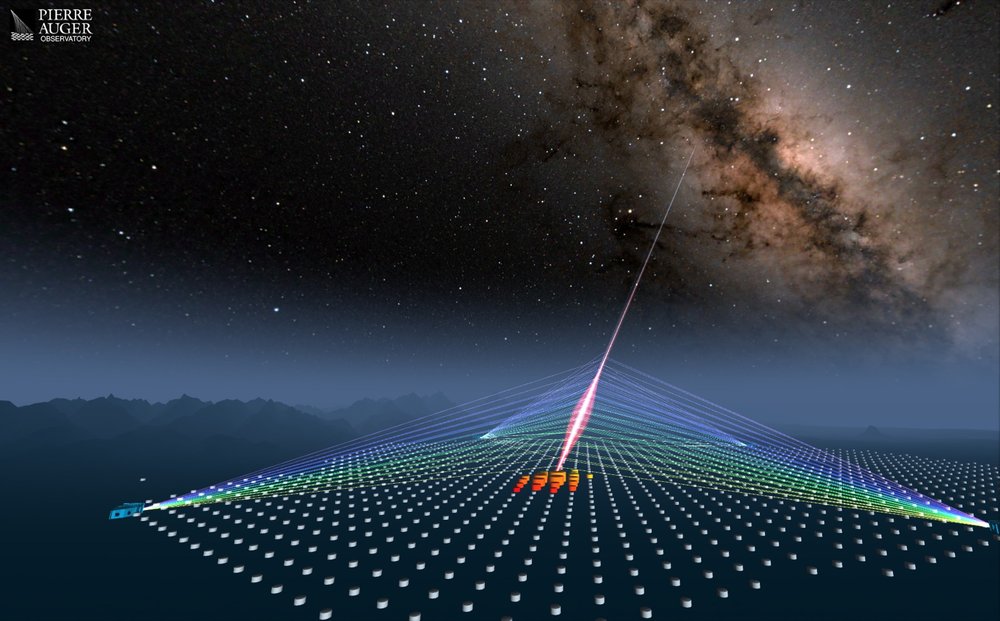
A cosmic-ray air shower as seen by the Pierre Auger Observatory's detector array. Credit: Pierre Auger Observatory.
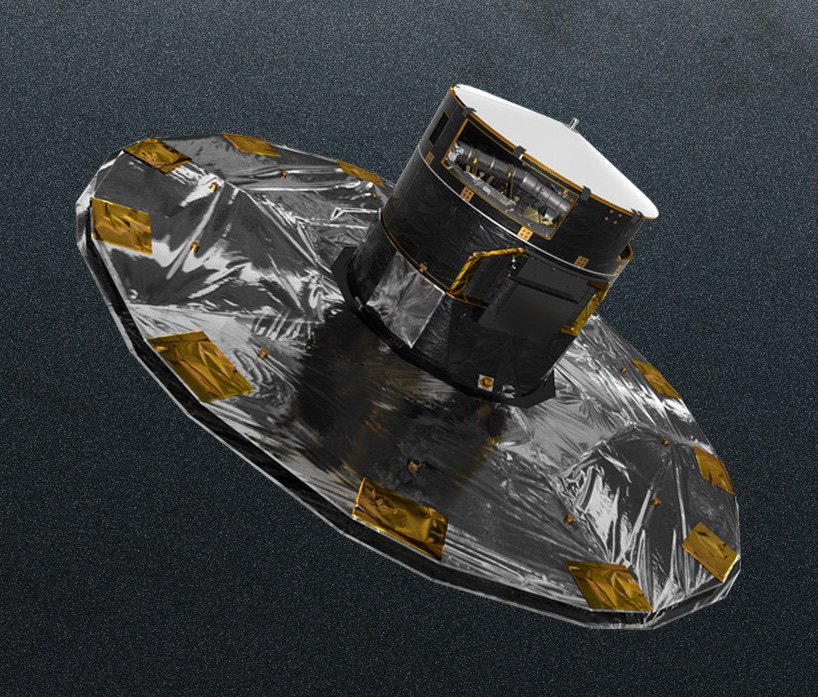
The Gaia spacecraft. Credit: ESA/ATG medialab; ESA/Gaia/DPAC; acknowledgement: A. Moitinho (CC BY-SA 3.0 IGO).
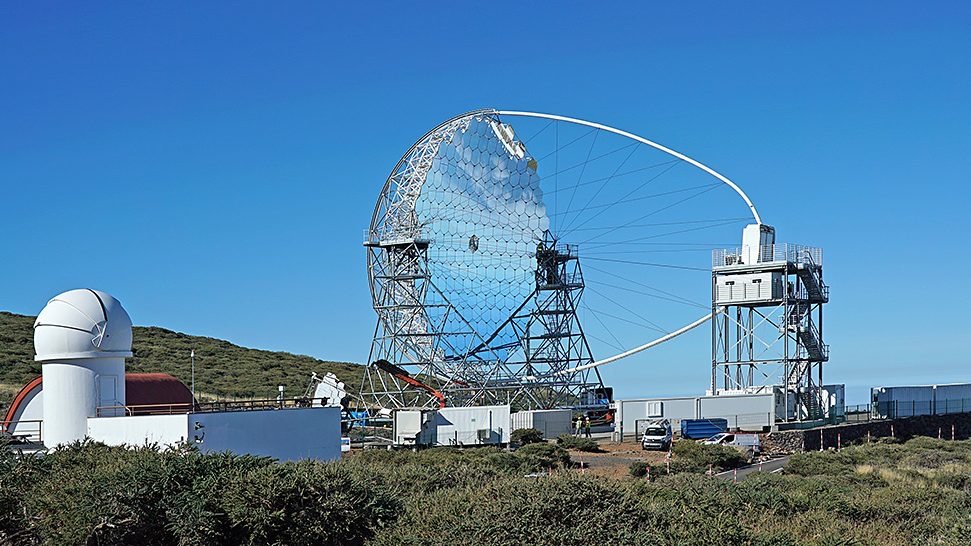
LST-1, CTAO's first Large-Sized Telescope, La Palma. Source: acme-astro.eu.
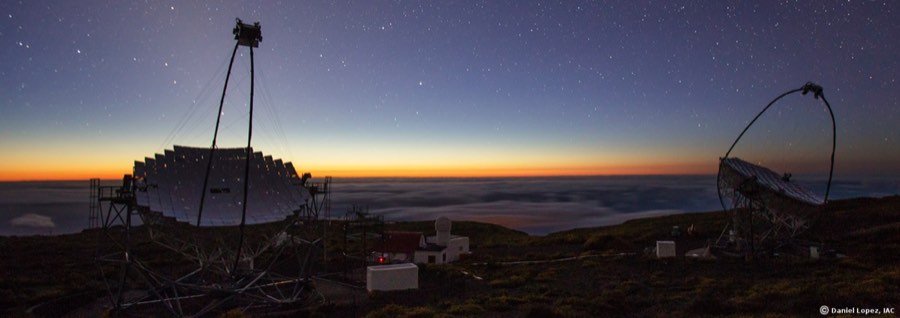
The MAGIC telescopes on La Palma. © Daniel López, IAC.
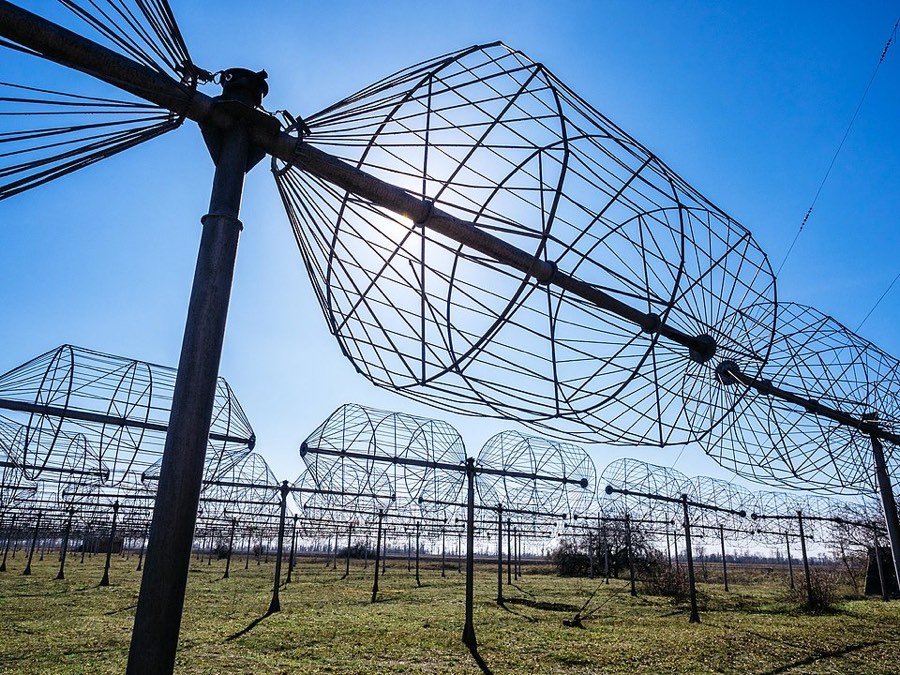
UTR-2, the Ukrainian T-shaped Radio telescope — the world's largest at decametre wavelengths. Source: acme-astro.eu.
Infrastructure and development
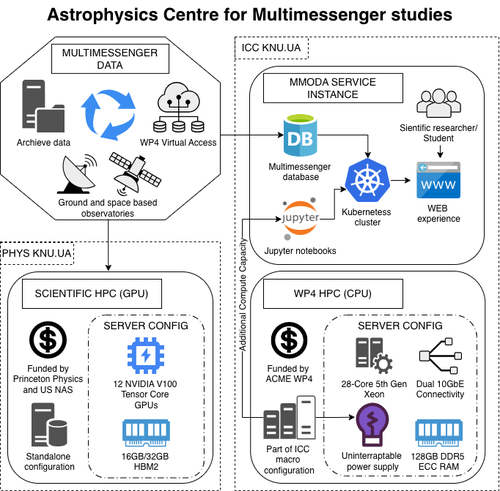
Architecture of the Kyiv node: data arrives through ACME WP4 virtual access, is processed on KNU's clusters, and reaches users via the web interface and Jupyter notebooks. Diagram: CCUSE LHEPA.
The Ukrainian MMODA node runs at odahub.k8s.esoc.knu.ua/mmoda on a Kubernetes cluster at KNU's Information and Computing Centre (10 nodes, 56 CPU cores, 112 GB RAM), mirroring the data-access, analysis and modelling services of the platform's main instance. Computing support is provided by the Faculty of Physics HPC servers; a GPU cluster is available for resource-intensive tasks.
For researchers and students
The platform is designed both for professional astrophysicists and for students: running an analysis requires neither specialized software nor computing resources of one's own. This makes MMODA a convenient tool for courses in high-energy astrophysics, for thesis work, and for quick tests of scientific hypotheses. Enquiries about using the platform in teaching can be sent via the contacts page.
Access
Launch MMODA →
Links: source code — github.com/oda-hub · the oda_api Python client — github.com/oda-hub/oda_api · the platform's main instance — astro.unige.ch/mmoda
Funding
The ACME project has received funding from the European Union Horizon Europe Research and Innovation programme under Grant Agreement No 101131928. Views and opinions expressed are however those of the author(s) only and do not necessarily reflect those of the European Union or of the European Research Executive Agency (REA). Neither the European Union nor the granting authority can be held responsible for them.