The ACME Project
Taras Shevchenko National University of Kyiv is a beneficiary of the Horizon Europe project ACME (Grant Agreement No 101131928). At the University, the work is carried out by CCUSE Laboratory of High Energy Physics and Astrophysics.
Overview
ACME (Astrophysics Centre for Multimessenger studies in Europe) is a research and innovation project of the European Union Horizon Europe framework programme, call HORIZON-INFRA-2023-SERV-01, topic HORIZON-INFRA-2023-SERV-01-02.
- Grant agreement: No 101131928
- Duration: 48 months, from 1 September 2024 to 31 August 2028
- Coordinator: Centre national de la recherche scientifique (CNRS), France; Scientific Coordinator — Prof. Antoine Kouchner (CNRS / Université Paris Cité), Co-coordinator — Paolo D’Avanzo (INAF, Italy)
- Consortium: 37 beneficiary institutions from 14 countries
- Budget: approximately €14.5 million; EU funding covers 100% of eligible costs
Multi-messenger astronomy studies astrophysical sources through several information carriers at once: electromagnetic radiation across all bands, neutrinos, cosmic rays and gravitational waves. Each channel is recorded by separate infrastructures with their own data formats, access procedures and software — so the main obstacle for such studies is not a lack of data, but its fragmentation.
Objectives
ACME implements the recommendations of the European strategic roadmaps APPEC and ASTRONET on coordinating research infrastructures in astrophysics and astroparticle physics. The principal objectives are:
- harmonized transnational and virtual access to leading research infrastructures for the entire scientific community;
- centres of expertise across the gamma-ray, X-ray, gravitational-wave, neutrino and cosmic-ray, optical and radio domains;
- science data management following the FAIR principles (Findable, Accessible, Interoperable, Reusable);
- interoperable rapid-alert systems for transient events, enabling fast follow-up observations;
- training of scientists and engineers;
- opening astrophysical datasets to neighbouring disciplines and engaging citizens in research.
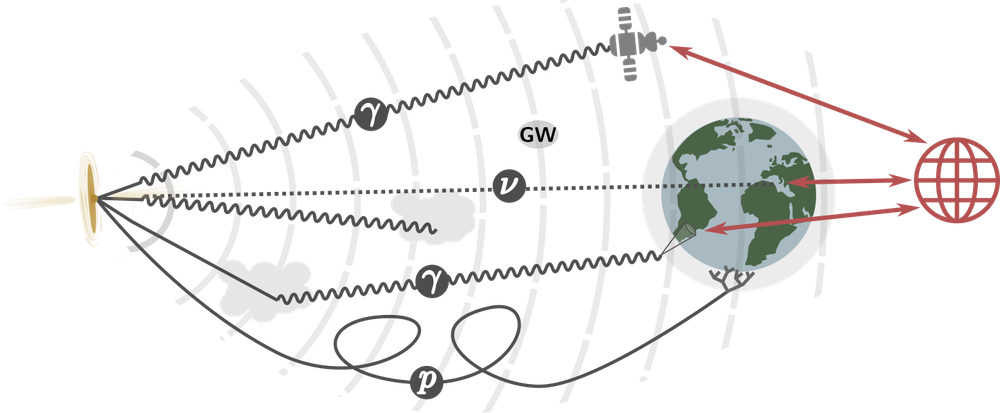
Four channels of information about a single source: photons, neutrinos, gravitational waves and cosmic rays. Illustration: ACME project.
Project structure
The work is organized into seven Work Packages:
- WP1. Management and coordination — CNRS / Université Paris Cité
- WP2. Telescopes and detectors — Max Planck Institute for Radio Astronomy (MPIfR)
- WP3. Centres of Expertise — Gran Sasso Science Institute (GSSI)
- WP4. Access to data archives and data analysis tools — Université Paris Cité / EPFL
- WP5. Realtime tools and follow-up observations — DESY and Humboldt University of Berlin
- WP6. Training — Max Planck Institute for Astronomy (MPIA)
- WP7. Environmental and citizen science — The Open University (UK)
The infrastructures involved include, among others, the CTAO observatory, the MAGIC Cherenkov telescopes, the Pierre Auger cosmic-ray observatory, the Virgo/EGO gravitational-wave detectors, the KM3NeT neutrino telescope, the LOFAR and EVN radio networks, and the archives of space missions.
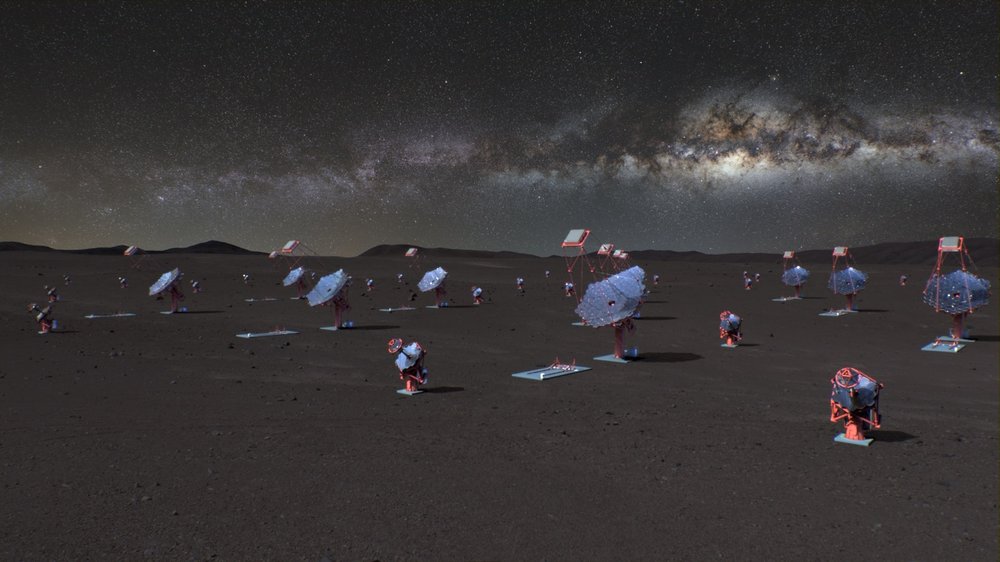
The CTAO southern site in the Atacama Desert. Credit: CTAO / Alba Fernández-Barral.
Participation of Taras Shevchenko National University of Kyiv
Taras Shevchenko National University of Kyiv is a project beneficiary with its own budget of €83,100. The second Ukrainian participant in the consortium is the Institute of Radio Astronomy of the NAS of Ukraine (Kharkiv).
At the University, the project is carried out by the Centre for Collective Use of Scientific Equipment Laboratory of High Energy Physics and Astrophysics (CCUSE LHEPA) of the Faculty of Physics, comprising the VIRGO.UA computing centre (the Virtual Roentgen and Gamma Observatory, working with data from the INTEGRAL, XMM-Newton, Chandra, Suzaku, Fermi, NuSTAR and Swift missions) and the Ukrainian Scientific Computing Centre for CTAO.
The main line of participation is Work Package WP4, Access to data archives and data analysis tools, within which the centre:
- contributes to harmonizing the standards for storing and exchanging multi-messenger data (virtual observatory tools, the VODF format, radio-data formats);
- provides access to telescope and detector data archives;
- develops data-analysis and modelling services, in particular based on the open Gammapy package;
- serves as the Ukrainian node of the MMODA platform, maintaining a mirror of its services;
- carries out educational and outreach activities.
In addition, the University team studies the characteristics of the Earth’s atmosphere within the ACME research infrastructure (related to WP7, Environmental and citizen science) and prepares informational materials to engage the public in data-analysis experiments.
Computing infrastructure
To host the MMODA platform, a Kubernetes cluster of 10 nodes (56 CPU cores, 112 GB RAM) has been deployed at the University Information and Computing Centre. Computing support is provided by the Faculty of Physics HPC servers based on 28-core 5th-generation Intel Xeon processors with 128 GB of DDR5 ECC memory and redundant power; a scientific GPU cluster is available for resource-intensive tasks.
Funding
The ACME project has received funding from the European Union Horizon Europe Research and Innovation programme under Grant Agreement No 101131928. Views and opinions expressed are however those of the author(s) only and do not necessarily reflect those of the European Union or of the European Research Executive Agency (REA). Neither the European Union nor the granting authority can be held responsible for them.
Links: official project website acme-astro.eu · project record in CORDIS · the MMODA service page